The science behind AcuSera.
How your body signals stress, how AcuSera detects it, and the research behind vibration therapy, the P6 acupoint and guided breathing.
On this page
What stress does to the body.
When you’re under stress, your nervous system shifts into high gear. Your heart beats faster and the natural variation between beats narrows. Sweat glands in your skin switch on. Blood flow to your skin shifts, and your skin temperature can drop.
Each person’s stress shows up a little differently. For one person it’s mostly in the heart, for another it’s mostly in the skin.10 That’s why AcuSera reads them together.
How AcuSera detects stress.
AcuSera’s algorithms analyze your heart rhythm, EDA, skin temperature and movement together, every few seconds, all day. From those readings they pull out the patterns that separate stress from everything else your body does: a flight of stairs, a hot room, a good song.
We trained and tested our model on data collected during controlled stress and rest sessions in the lab.
Vibration therapy on the wrist.
Researchers have been studying how gentle, rhythmic vibration on the body affects stress. In a controlled trial, people wore a wrist device while preparing to give a public speech. Those who felt a slow vibration, slower than their own heartbeat, reported less anxiety and showed smaller sweat responses than people whose device stayed off.1
In a Stanford lab study, a vibration pattern people could breathe along with reduced anxiety during a stressful task, compared with a control group.2
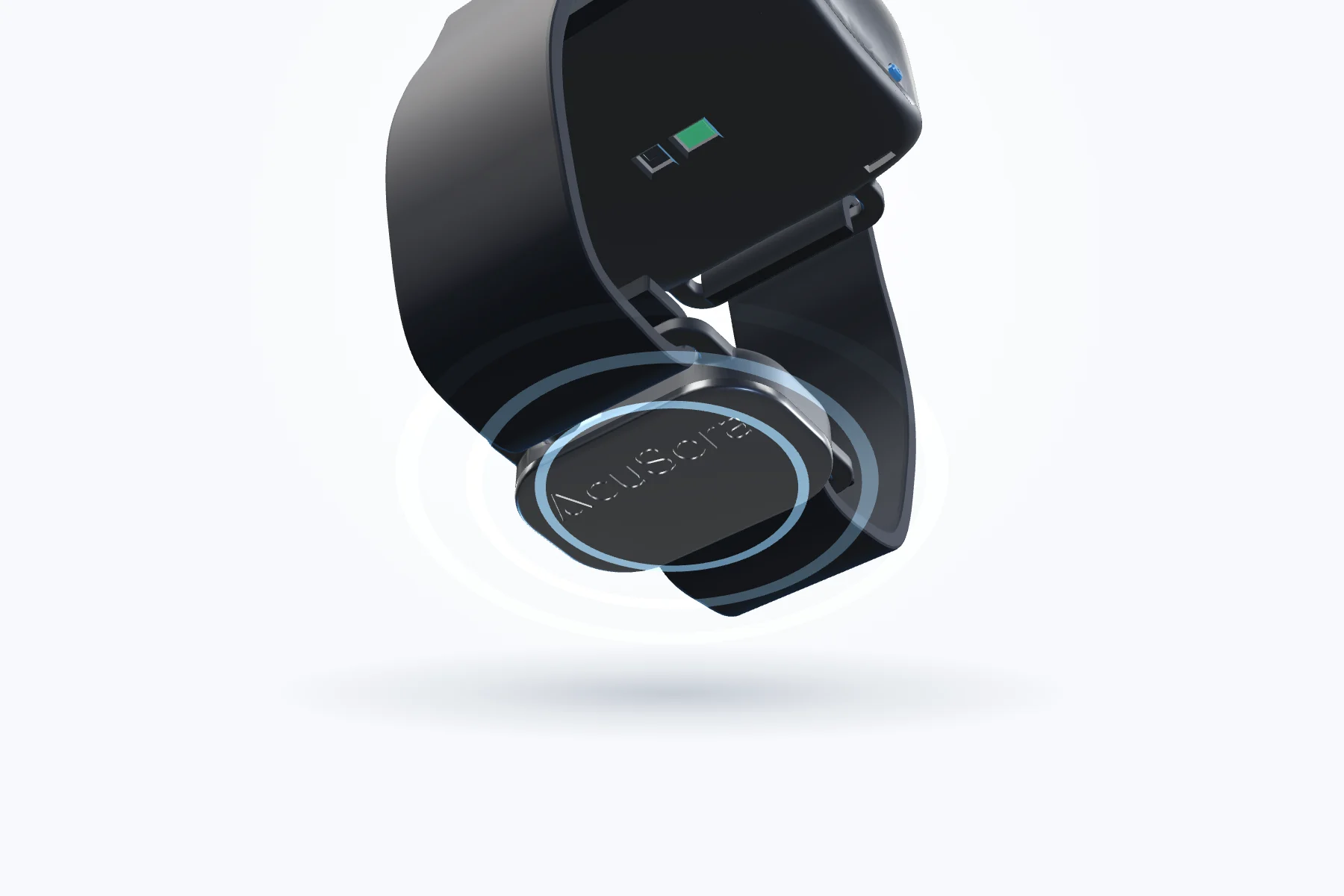
AcuSera builds on this work: a gentle, rhythmic vibration, delivered at the wrist, at the moment stress builds.
The P6 acupoint.
P6, also called PC6 or Neiguan, is an acupoint on the inner wrist, about three finger-widths up from the crease, between the two tendons. It’s one of the most studied acupoints in clinical research.
A Cochrane review of 59 trials found that stimulating P6 reduces nausea after surgery,5 which is why anti-nausea wristbands press on it. Meta-analyses of randomized trials have found that acupressure reduced anxiety compared with control groups.3,4
AcuSera brings P6 something it never had: timing. Instead of a band you press when you remember, the vibration therapy starts on its own the moment your body shows stress building.
Guided breathing you can feel.
Slow, structured breathing is one of the best-studied ways to calm the body’s stress response, and a slow exhale is at the heart of most techniques.
AcuSera’s P6 vibration is also your breathing guide, so both happen at once. By default the vibration swells for 4 seconds as you breathe in and fades for 7 as you breathe out, a long, slow exhale. No screen to look at, so you can do it in the middle of a meeting. You can switch to the patterns below in the app.
Box breathing
In 4, hold 4, out 4, hold 4
Equal counts on every side. In a randomized Stanford study of 108 people, five minutes a day of structured breathing, including box breathing, improved mood and reduced anxiety over a month.7
4-7-8
In 4, hold 7, out 8
A long hold and an even longer exhale. In healthy adults, 4-7-8 breathing increased heart rate variability, a marker of the body’s calming response.8
Slow breathing
About 6 breaths a minute
A smooth, slow rhythm, sometimes called resonance breathing. A review of 223 studies found slow breathing consistently increased the heart rate variability linked to rest and recovery.9
Our own clinical study.
The research above shows what vibration, P6 and slow breathing can do. Next, we’re testing AcuSera itself.
We’re launching a clinical study with academic medical researchers in Kansas City to measure how accurately AcuSera detects stress as it happens, and how people respond to its vibration therapy and guided breathing.
AcuSera is a wellness device. It isn’t a medical device, and it isn’t designed to diagnose, treat, or prevent any condition. The studies cited above tested other devices and methods.
Be one of the first to wear it.
Reserve a Founders Club spot for $10, fully refundable, and get 10% off the $299 launch price. Or join the free waitlist.
References.
- Azevedo RT, Bennett N, Bilicki A, Hooper J, Markopoulou F, Tsakiris M. The calming effect of a new wearable device during the anticipation of public speech. Scientific Reports 7:2285, 2017. PubMed
- Miri P, Jusuf E, Uusberg A, Margarit H, Flory R, Isbister K, Marzullo K, Gross JJ. Evaluating a personalizable, inconspicuous vibrotactile (PIV) breathing pacer for in-the-moment affect regulation. Proceedings of CHI 2020, ACM. Stanford HCI
- Au DWH, Tsang HWH, Ling PPM, Leung CHT, Ip PK, Cheung WM. Effects of acupressure on anxiety: a systematic review and meta-analysis. Acupuncture in Medicine 33(5):353–359, 2015.
- Chen S-R, Hou W-H, Lai J-N, Kwong JSW, Lin P-C. Effects of acupressure on anxiety: a systematic review and meta-analysis. Journal of Integrative and Complementary Medicine 28(1):25–35, 2022.
- Lee A, Chan SKC, Fan LTY. Stimulation of the wrist acupuncture point PC6 for preventing postoperative nausea and vomiting. Cochrane Database of Systematic Reviews, 2015, CD003281.
- Fincham GW, Strauss C, Montero-Marin J, Cavanagh K. Effect of breathwork on stress and mental health: a meta-analysis of randomised-controlled trials. Scientific Reports 13:432, 2023. Full text
- Balban MY, Neri E, Kogon MM, et al. Brief structured respiration practices enhance mood and reduce physiological arousal. Cell Reports Medicine 4(1):100895, 2023. Full text
- Vierra J, Boonla O, Prasertsri P. Effects of sleep deprivation and 4-7-8 breathing control on heart rate variability, blood pressure, blood glucose, and endothelial function in healthy young adults. Physiological Reports 10(13):e15389, 2022. Full text
- Laborde S, Allen MS, Borges U, et al. Effects of voluntary slow breathing on heart rate and heart rate variability: a systematic review and a meta-analysis. Neuroscience and Biobehavioral Reviews 138:104711, 2022.
- Lacey JI, Lacey BC. Verification and extension of the principle of autonomic response-stereotypy. American Journal of Psychology 71(1):50–73, 1958.
- Boucsein W. Electrodermal Activity, 2nd ed. Springer, 2012.